AI-Ready Data Is Not Analytics-Ready Data
The most expensive assumption in enterprise AI today is that a data platform built for analytics is automatically ready to…

Logic pursuits

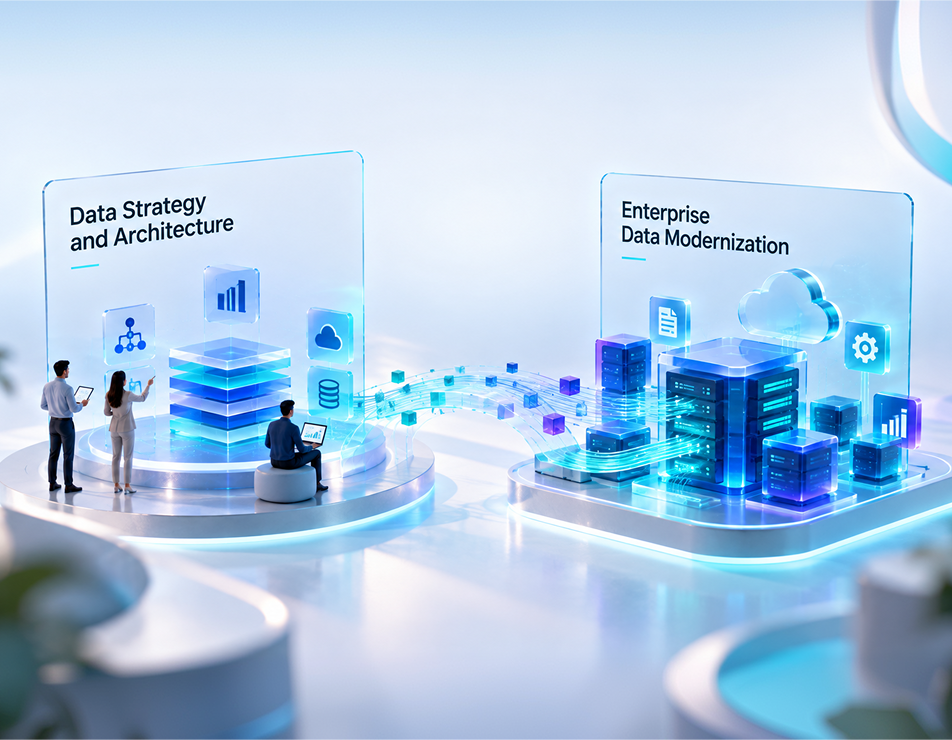
Cloud adoption is at an all-time high, yet many enterprises still struggle to answer basic business questions with confidence. The gap between a migrated data estate and a modern one comes down to governance, ownership, and a handful of decisions made early.
Ask ten enterprise technology leaders whether their organization has modernized its data landscape, and most will say yes. After all, the data now lives in the cloud. Yet many of those same organizations still reconcile figures by hand before leadership meetings, still run overnight loads that fail silently, and still pay for three tools that do the same job. The data moved; the problems came along for the ride.
That is because cloud migration changes where a data estate runs, not how it behaves. Modernization is an architectural and organizational transformation, and its destination is not “the cloud.” It is a governed platform: one where data has a deliberate home, movement is automated and observable, definitions are consistent, access is controlled by policy, and critically, the organization that owns the platform can actually run it. This article sets out what that end state looks like, the anti-patterns that masquerade as progress, the decisions and components that matter most, and how we help our clients get there.
“Modern” is not a shopping list of tools, and it is certainly not a synonym for “cloud.” In practice, a modern data architecture has five observable properties. Data has a single governed home (or a small number of deliberate ones), rather than an accidental sprawl of copies. Data movement and transformation are automated, version-controlled, and observable, so failures surface to engineers before business users notice them. Business definitions are consistent: revenue means the same thing in every dashboard. Access is governed by policy rather than tribal knowledge and shared credentials. And the organization can operate, change, and extend the platform with its own people.
A stack can be entirely cloud-native and fail every one of these tests. Modern is a set of behaviours that the architecture makes routine, not a procurement outcome.
Two failure modes dominate, and they sit at opposite ends of a spectrum.
The first is the siloed lake. Inexpensive cloud storage made it easy for every department to stand up its own lake, warehouse, or “analytics environment.” Each one is locally rational; collectively they recreate the fragmentation the organization was trying to escape, only now with a larger bill. Integration effort gets pushed downstream onto analysts, the same customer exists in five different shapes, and executive meetings open with a debate about whose number is right.
The second is the over-engineered monolith: a single central platform wrapped in bespoke frameworks and abstraction layers, run by one team through which every request must pass. It looks disciplined. In practice, delivery slows to the speed of the queue, the frameworks outlive the people who understood them, and the business quietly routes around the platform, usually by building siloed lakes.
A third pattern deserves mention because it so often hides inside “successful” cloud programs: lift-and-shift as an end state. Recreating legacy jobs one-for-one on cloud infrastructure simply transfers technical debt to a new landlord. In one engagement with a leading global cruise operator, we found customer and reservation data traversing three separate legacy integration technologies — SSIS, IBM Integration Bus, and App Connect — before it ever reached the CRM, adding latency, failure points, and support overhead. Every component had been dutifully maintained for years. Nothing about the landscape was modern.
In our experience, the long-term health of a data platform is determined less by tool selection than by five decisions — most of which are made, deliberately or by default, in the first ninety days of a program.
Make those five decisions well, and they materialize as the five components that every governed architecture shares: a consolidated cloud data platform, automated pipelines, embedded governance, a semantic layer, and the one most often skipped: team capability.
The cloud data platform is the consolidated core where analytical data lives, with elastic compute and workload isolation. Consolidation is also where fragmentation costs become visible and reversible. For the cruise operator above, we replaced the three-technology integration layer with a centralized architecture built on Snowflake, with Fivetran for ingestion and dbt and Matillion for transformation and integration. The redesign cut annual integration maintenance costs by roughly 30% and lifted SLA adherence from 85% to 95% — the difference between teams double-checking the data and teams trusting it.
Automated pipelines are where legacy estates carry the most hidden debt. When the same client faced the decommissioning of SAP Data Services, the estate held roughly 260 business-critical jobs, largely undocumented. Rather than a one-for-one lift, the jobs were inventoried, their lineage and dependencies mapped, and the logic re-engineered into parameterized, version-controlled dbt and Matillion pipelines, migrated in multiple waves grouped by complexity. The modernized pipelines increased data throughput by 40%, cut query response times by 60%, and eliminated an estimated $500K in annual licensing and maintenance costs — while producing, for the first time, complete documentation of what the estate does.
Governance, in a modern architecture, is not a committee; it is infrastructure. Role-based access, data classification and masking, lineage, and automated quality tests are expressed as code and enforced by the platform, so being governed is the default state of every new dataset rather than an audit finding on old ones.
The semantic layer is where governed data becomes trusted answers: certified, reusable definitions of the metrics the business runs on, consumed identically by every BI tool, application, and increasingly every AI assistant that sits on top of the platform.
Team capability is the component that determines whether the other four survive contact with year two. Platforms do not stay modern on their own; they stay modern because the people who own them understand every design decision and can make the next one unaided.
It is worth being explicit about what a governed foundation buys. For the same operator, once customer engagement data was unified and reliable, our data science team could build a monthly, customer-level behavioural dataset spanning multiple brands and use multi-scenario machine learning to optimize direct-mail and email frequency — identifying segments with two to ten times higher responsiveness and redirecting spend accordingly. That kind of personalization program is simply not buildable on a fragmented estate. Advanced analytics is not a parallel initiative to modernization; it is the dividend.
Platform selection attracts enormous attention, but the principles that make an architecture durable are strikingly consistent whether the core is Snowflake, Databricks, or a hyperscaler-native stack on AWS, Azure, or Google Cloud. Exploit the separation of storage and compute, and design cost governance in from the start, because elasticity without guardrails becomes an invoice. Express transformations as code under version control, with testing and CI/CD, rather than as artifacts locked inside proprietary GUIs. Layer the architecture deliberately — raw, conformed, consumption — and treat curated datasets as products with owners and contracts, not as by-products of individual projects. Implement security and governance as code so that policy scales with the platform instead of with headcount. And prefer open table formats and interoperable standards where practical, so tomorrow’s architectural choices remain yours to make.
Our engineering heritage runs deepest in the Snowflake ecosystem — we are a Snowflake Premier Partner, and much of the delivery experience cited in this article comes from Snowflake, dbt, Matillion, and Fivetran estates. But the principles above are deliberately platform-agnostic, and we hold to them wherever a client’s workloads, skills, and existing investments point. Architecture should follow the organization’s realities, not a vendor allegiance.
Modernization programs rarely fail loudly; they fade, declaring victory at cutover and leaving the last, hardest mile: decommissioning, adoption, ownership un-walked. “Done” deserves a harder definition, and it is measurable.
The legacy estate is actually retired, with the savings banked: in the SAP Data Services program above, that meant roughly $500K per year in eliminated licensing and maintenance, not a parallel-run purgatory where both stacks quietly persist. Reliability is quantified as SLA adherence on data delivery — moving from 85% to 95% changes how an organization behaves, because people stop building shadow safety nets. Performance shows up as time-to-insight: query response times down 60%, overnight windows shortened, throughput up 40%. Cost per workload is visible and trending predictably. Adoption is observable in the numbers: certified data products in active use, and one-off extracts declining. And self-sufficiency — the most telling metric of all is the share of platform changes shipped by the client’s own team. If these numbers cannot be produced, modernization is not done.
Reaching that end state reliably is a matter of sequence as much as skill. We deliver modernization programs through a five-phase model, and each phase exists to make the governed end state inevitable rather than aspirational.
There is a reason so many modernization programs regress within eighteen months of the consultants leaving: the platform was built for the client, not with them. Handover decks and recorded walkthroughs do not transfer ownership; they transfer files.
Our answer is a working philosophy we call co-design and stay embedded. Co-design means the client’s architects and engineers are in the room from Discovery onward, and every consequential decision about the platform is made with the people who will live with it, so the reasoning transfers along with the design. Stay embedded means we remain through parallel run and into optimization, working as one delivery team and deliberately inverting the ratio over time: Our team leads early, the client’s team leads later, and by the final phase our role is review and reinforcement rather than build. Enablement is not a workstream tacked onto the end; it is how the work is done.
Moving from fragmented to governed is not a tooling purchase, and it is not finished at cloud go-live. It is a sequence of deliberate decisions, about data gravity, pipelines, governance, semantics, and people — delivered through a model that proves the design, validates the results, and builds ownership into the process itself. The organizations that get this right stop debating whose number is correct and start asking better questions of data they finally trust. If your estate looks more fragmented than governed, that is a solvable problem — and it starts with honest discovery of what you have.
Author